Quarantining Autonomous SRE Agents: Zero-Trust Istio Mesh Architecture on Kubernetes
TL;DR: Autonomous AIOps agents must never be granted unrestricted Kubernetes cluster privileges. By embedding the NEXUS operations agent inside an Istio service mesh with SPIFFE identities, strict mutual TLS, and granular sidecar AuthorizationPolicies, platform teams enable real-time telemetry diagnosis while physically blocking the agent from touching production application pods.
- 1. Why Granting kubectl Permissions to LLMs Is a Critical Threat
- 2. The Istio + SPIFFE Blast Radius Quarantine
- 3. Step-by-Step Configuration: Istio Security Policies
- 4. Validating Resilience with Chaos Mesh (56.5% Error Rate Test)
- 5. Comparison: AI Operations Security Models
- 6. Common Security Mistakes with AI SRE Tools
- 7. Frequently Asked Questions
- 8. Conclusion & Key Takeaways
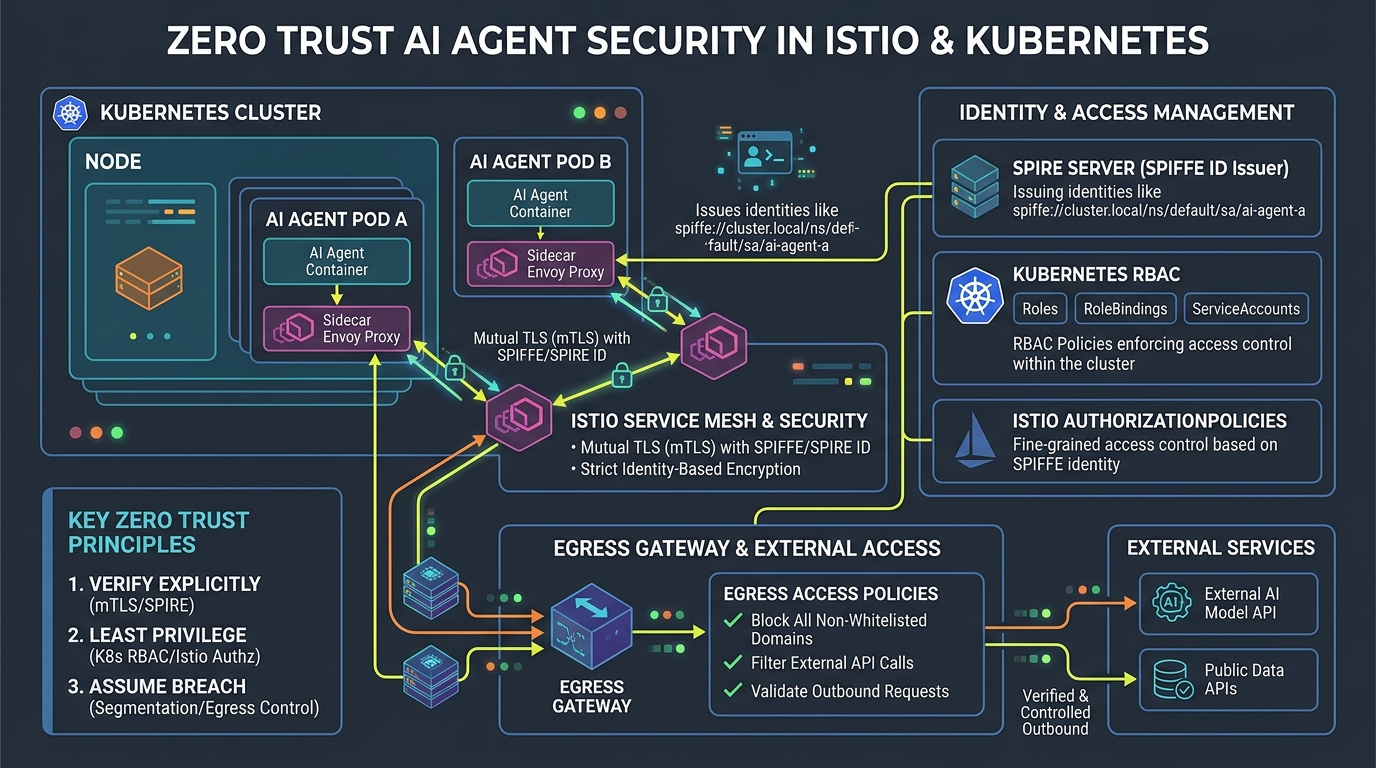
Why Granting kubectl Permissions to LLMs Is a Critical Threat
Giving an LLM-powered operations agent cluster-admin RBAC or kubectl exec access is an architectural failure.
In production Kubernetes clusters, unconstrained AI agents introduce three unacceptable risks: 1. Prompt Injection via Telemetry: A malicious payload embedded in an HTTP header or log line can hijack the agent's reasoning loop and trick it into running destructive commands. 2. Cascading Failure Loops: An agent observing high memory usage might start deleting pods during a database failover, turning a temporary slow-down into a full outage. 3. Audit Impossibility: If an LLM runs raw shell commands directly against cluster APIs, reconstructing the incident timeline during a post-mortem becomes impossible.
The solution is zero trust: treating the AI agent pod as an untrusted workload with zero network reach into application pods.
┌────────────────────────────────────────────────────────────────────────┐
│                   Kubernetes Cluster (Amazon EKS)                      │
│                                                                        │
│  ┌─────────────────────────┐              ┌─────────────────────────┐  │
│  │   ai-agent Namespace    │              │  lsd-payments Namespace │  │
│  │  ┌───────────────────┐  │              │  ┌───────────────────┐  │  │
│  │  │ NEXUS AIOps Pod   │  │   STRICT     │  │ Application Pods  │  │  │
│  │  │ (Claude Sonnet)   │  │    mTLS      │  │ (Payments Backend)│  │  │
│  │  └─────────┬─────────┘  │              │  └─────────▲─────────┘  │  │
│  │            ▼            │              │            │            │  │
│  │  ┌───────────────────┐  │              │  ┌─────────┴─────────┐  │  │
│  │  │   Envoy Sidecar   │──┼──────────────┼──│   Envoy Sidecar   │  │  │
│  │  └─────────┬─────────┘  │  DENY Policy │  └───────────────────┘  │  │
│  └────────────┼────────────┘              └─────────────────────────┘  │
│               │                                                        │
│       ALLOW   │ Telemetry Read Only                                    │
│               ▼                                                        │
│  ┌──────────────────────────────────────────────────────────────────┐  │
│  │                     istio-system Namespace                       │  │
│  │           Prometheus  •  Jaeger Traces  •  Kiali Topology        │  │
│  └──────────────────────────────────────────────────────────────────┘  │
└────────────────────────────────────────────────────────────────────────┘
The Istio + SPIFFE Blast Radius Quarantine
To isolate NEXUS while allowing it to diagnose issues, the architecture enforces three strict boundaries:
1. Cryptographic SPIFFE Identity
NEXUS runs with an identity minted by Istio (spiffe://cluster.local/ns/ai-agent/sa/ai-agent-sa). All communication inside the mesh requires mutual TLS (mode: STRICT).
2. Sidecar Layer-7 AuthorizationPolicies
Istio Envoy sidecars enforce network boundaries:ALLOW: Read-onlyGETqueries to Prometheus (http://prometheus.istio-system:9090) and Jaeger.DENY: All TCP/HTTP connections to application namespaces (lsd-payments,frontend).
3. Decoupled Click-to-Approve Remediation
NEXUS outputs structured JSON diagnostic reports containing the root cause and proposed fix. It cannot apply changes directly; execution requires an on-call engineer's approval in Grafana Cloud IRM or Discord.Step-by-Step Configuration: Istio Security Policies
Step 1: Isolate the Agent Namespace
Create the namespace with automatic Istio sidecar injection:apiVersion: v1
kind: Namespace
metadata:
name: ai-agent
labels:
istio-injection: enabled
apiVersion: v1
kind: ServiceAccount
metadata:
name: ai-agent-sa
namespace: ai-agentStep 2: Apply Layer-7 AuthorizationPolicies
Allow Prometheus telemetry reads while dropping all outbound traffic to payment services:# Allow Read-Only Access to Prometheus in istio-system
apiVersion: security.istio.io/v1beta1
kind: AuthorizationPolicy
metadata:
name: allow-telemetry-read
namespace: istio-system
spec:
selector:
matchLabels:
app: prometheus
action: ALLOW
rules:
- from:
- source:
principals: ["cluster.local/ns/ai-agent/sa/ai-agent-sa"]
to:
- operation:
methods: ["GET"]
# Deny Direct Communication to Application Pods
apiVersion: security.istio.io/v1beta1
kind: AuthorizationPolicy
metadata:
name: deny-app-workloads
namespace: lsd-payments
spec:
action: DENY
rules:
- from:
- source:
principals: ["cluster.local/ns/ai-agent/sa/ai-agent-sa"]Step 3: Implement the Telemetry Polling Loop
NEXUS continuously monitors Prometheus error rate metrics:import requests
import json
from typing import Dict, Any
def evaluate_mesh_telemetry() -> None:
"""
Polls Prometheus for HTTP 5xx error rate anomalies across the service mesh.
"""
prom_query = 'sum(rate(istio_requests_total{response_code=~"5."}[1m])) / sum(rate(istio_requests_total[1m]))'
res = requests.get(
"http://prometheus.istio-system:9090/api/v1/query",
params={"query": prom_query},
timeout=5.0
)
data = res.json()
error_rate = float(data["data"]["result"][0]["value"][1])
if error_rate > 0.05:
trigger_ai_diagnosis(error_rate)
def trigger_ai_diagnosis(error_rate: float) -> None:
print(f"Mesh error rate threshold breached: {error_rate 100:.2f}%. Triggering Claude Sonnet diagnosis.")
Validating Resilience with Chaos Mesh (56.5% Error Rate Test)
To test the isolation and diagnostic capability, we injected a NetworkChaos packet delay into the payment service:
1. Detection (0:30): NEXUS caught a 56.5% error spike within a single 30-second polling cycle.
2. Diagnosis (1:15): Claude Sonnet isolated the fault to lsd-backend, ruled out DNS failures, and flagged a telemetry NaN artifact.
3. Gated Remediation (2:00): NEXUS published a 6-step mitigation plan to Grafana IRM. An engineer clicked "Approve", triggering a worker to clear the Chaos Mesh experiment.
4. Recovery (3:45): Synthetic probes verified 100% traffic recovery. At no point did the AI pod have direct access to payment workloads.
Comparison: AI Operations Security Models
| Security Dimension | Unconstrained Root Agent | Kubernetes RBAC Only | Zero Trust Istio Mesh (NEXUS) |
| :--- | :--- | :--- | :--- |
| Identity Mechanism | Static API Key | ServiceAccount Token | SPIFFE Cryptographic Certificate |
| Network Boundary | Unrestricted Flat Mesh | Layer 3/4 NetworkPolicy | Layer 7 Envoy Sidecar AuthPolicy |
| App Pod Access | Full Read/Write | Namespace Scoped | Cryptographically Blocked (DENY) |
| Remediation Model | Direct autonomous kubectl | Webhook Trigger | Human Click-to-Approve Gate |
| Compromise Risk | Full Cluster Takeover | Namespace Compromise | Zero (Agent Isolated in Sandbox) |
Common Security Mistakes with AI SRE Tools
- Granting Direct Cluster RBAC to Agents: Giving an LLM
kubectlwrite permissions turns any prompt injection into a cluster compromise. - Relying Exclusively on L3/L4 NetworkPolicies: IP-based firewalls cannot enforce SPIFFE cryptographic identity or HTTP GET/POST method boundaries.
- Automating Unverified Destructive Fixes: Pod terminations and DB failovers must require human confirmation.
Frequently Asked Questions
How does Istio prevent an AI agent from attacking application pods?
Istio sidecar proxies enforce layer-7AuthorizationPolicy rules that drop all network connections originating from the agent's SPIFFE principal toward application namespaces.
What is the role of SPIFFE in AI agent security?
SPIFFE provides an immutable, cryptographically verifiable identity embedded in mutual TLS certificates, ensuring the service mesh accurately recognizes the agent on every network hop.Can NEXUS automatically fix production outages?
NEXUS generates structured remediation plans, but actual execution requires human confirmation via Grafana Cloud IRM or webhook approval gates.How does NEXUS ingest cluster metrics safely?
NEXUS communicates with Prometheus and Jaeger via read-only HTTP GET endpoints permitted under specific Istio sidecar authorization rules.What happens if the AI agent's LLM hallucinates a remediation command?
Because the agent lacks Kubernetes API write permissions, hallucinated commands cannot execute directly against production infrastructure.Conclusion & Key Takeaways
AI agents bring speed to root-cause diagnosis, but production reliability requires architectural isolation. By combining Amazon EKS, Istio service mesh, SPIFFE identity, and human approval gates, platform teams get fast incident analysis without handing cluster keys to an LLM.
Frequently Asked Questions (FAQ)
What is the core takeaway of this guide?
This guide establishes production patterns and verifiable architecture standards designed to eliminate engineering friction, improve reliability, and optimize system performance.
How can teams implement these patterns safely?
Start by auditing your current pipeline, applying clear boundaries, enforcing verification commands on disk, and introducing automated checks gradually.
Where can I find additional technical reference code?
Check the StackScout open-source repository on GitHub for full runnable code samples, architecture benchmarks, and continuous deployment configurations.
Scaffolding vs. Intelligence: Why AI Evaluation Harnesses Fake 70-Point Leaps
Why AI evaluation harness architectures create massive score spreads on benchmarks like ARC-AGI-3, and how to establish strict benchmark provenance.
Read article →Beyond the Hype: My Production Workflow with Claude Code
A battle-tested guide to coding with Claude Code. Learn the Design-Plan-Execute framework, repository setup, delegated tasks, and failure modes.
Read article →